
Applications · Notes
WDM PON: replacing the splitter with a wavelength router
One fiber to the subscriber in both cases. TDM PON shares time; WDM PON gives each home its own wavelength.
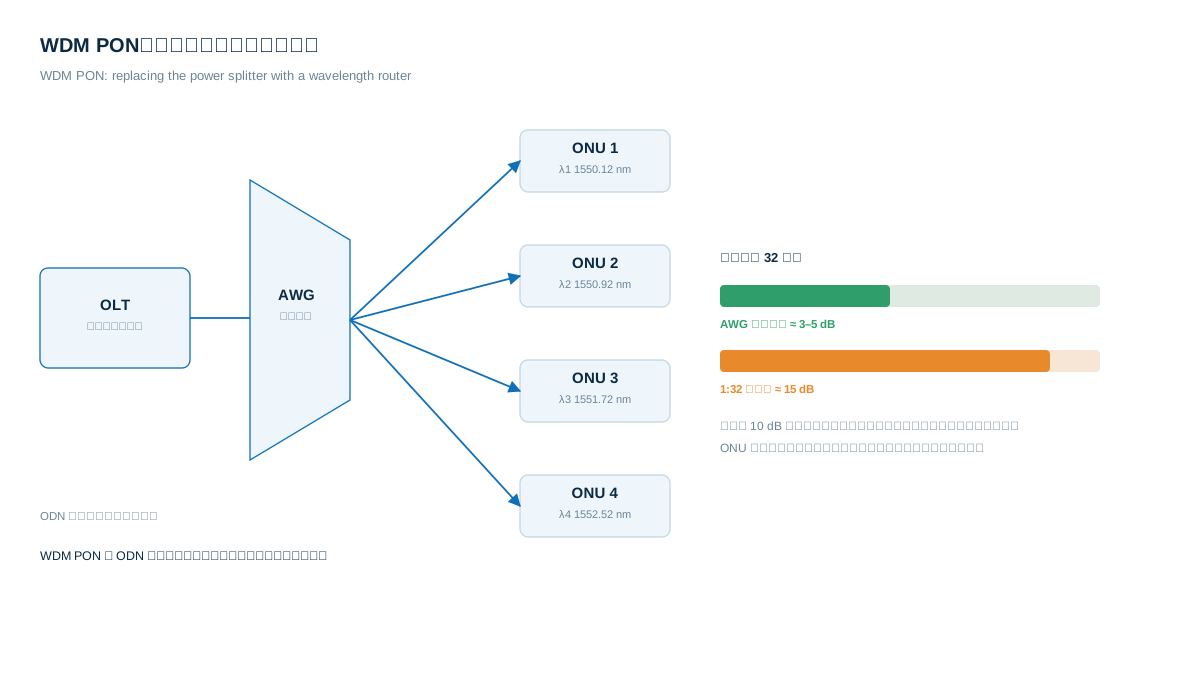
The structural difference
The OLT emits several wavelengths. A cyclic AWG combines them onto the feeder fiber to the remote node (RN), where a second AWG routes each wavelength to its own ONU. Every subscriber owns a wavelength; there is no power splitter in the path.
Compare with TDM PON: a 1:32 splitter alone costs about 15 dB, so reach and split ratio fight each other for the power budget. WDM PON routes instead of splitting, and the loss comes down to a few dB of AWG insertion loss, leaving far more headroom and longer reach.
Two things that come for free
- Physical isolation: each home receives only its own wavelength, which is far harder to tap than a shared downstream
- Graceful growth: add wavelengths to add subscribers, without changing the split ratio or the feeder fiber
Where projects usually go wrong
The free spectral range of the AWG has to match the wavelength plan. Too small an FSR makes wavelengths wrap around onto neighbouring ports: a few subscribers talk to each other while others stay dark, and the fault is slow to find. Wavelength drift at the ONU is also amplified by an athermal AWG, so outdoor ONUs need margin for temperature.
Related products: AWG modules · PLC splitters · Isolators & PM components