
Applications · Notes
FTTH: the last twenty metres are the delicate part
From the head end to the riser it is routine work. The drop cable into the flat decides whether it holds.
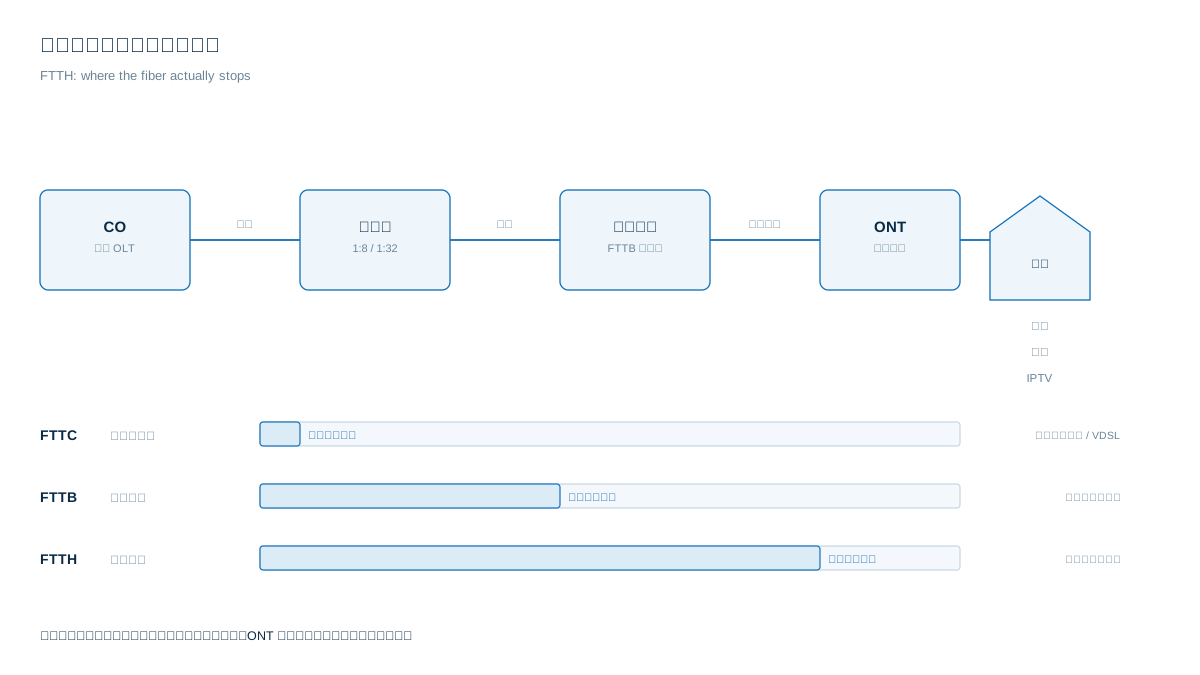
One step apart, three names
- FTTC: fiber to the cabinet, the last 100-300 m is copper or coax
- FTTB: fiber to the building, distributed inside over LAN cable or VDSL
- FTTH: fiber all the way in, with the ONT sitting in the living room
All three can hang off the same OLT. What differs is where the light stops and what carries the last segment. In practice that last segment is the expensive one: trenching for copper, terminating cable, or getting a drop cable into a flat.
The chain and its parts
OLT in the CO, feeder cable, FDT or street cabinet, splitter, drop cable, ONT, router. The parts list is short: G.652D for the feeder, 3 mm or 2 mm drop cable indoors, a 1:8 or 1:16 splitter matched to subscriber count, and splices or field-installable connectors depending on site conditions.
Where installation goes wrong
**Bend radius.** A 3 mm drop cable wants about 30 mm minimum. Pinched in a door frame or bent square, loss creeps up over days and may not show on the day of the test.
**Splice loss.** Budget 0.1 dB per fusion splice and 0.3 dB per field connector; across a dozen flats in one block that adds up to 3-5 dB and must be in the margin.
**ONT power.** The ONT needs a 12 V adaptor and dies with the mains. Either give it its own small UPS or put ONT and router behind the same household UPS, not the router alone.
Related products: PLC splitters · MPO / MTP connectivity · Isolators & PM components