
Applications · Notes
MPO backbone in the data center: MDA to rack
High-density links between buildings and inside the hall, carried by an MPO backbone.
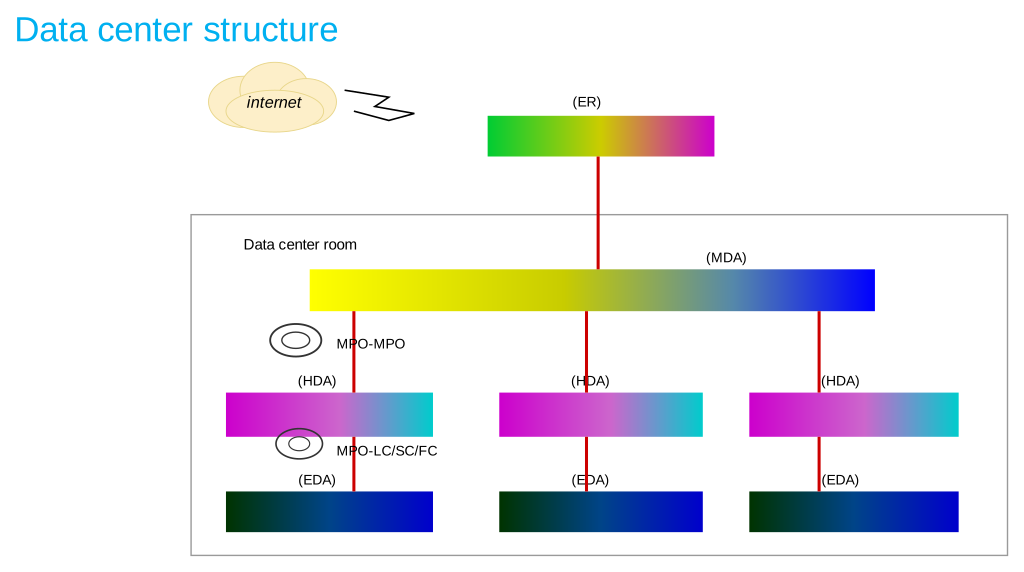
How the link runs
Carrier or metro fiber terminates in the entrance room (ER) and runs to the main distribution area (MDA). MPO trunk cables connect the MDA to each hall’s horizontal distribution area (HDA), and the HDA feeds equipment distribution areas (EDA). At the rack, an MPO-to-LC fan-out breaks the trunk into individual LC pairs for the server NICs.
Every segment wants low insertion loss and high density: 12 fibers take 12 LC port positions but a single MPO port. 40G/100G SR4 and PSM4 modules are native MPO, so converting the trunk to LC too early only adds a needless adapter.
What we supply
- MPO trunk cables: 12F or 24F, OM4 or OS2, polarity B (straight) most common
- MPO-to-LC fan-outs: 8F and 12F, modular cassette or cable type
- MPO adapters and patch panels for MDA / HDA cross-connects
- LC patch cords for the last metres inside the rack
Three common mistakes
Wrong polarity. Choose A, B or C inconsistently and the transmit and receive fibers no longer line up: the link comes up but error rates are poor. Keeping both trunk ends on polarity B is simplest; the fan-out does the crossover.
Mismatched end-face polish. Mixing APC and UPC raises insertion loss and ruins return loss. MPO end faces are usually UPC or APC flat-polished, so specify them together with the transceiver.
Poor cleaning. An MPO ferrule has 12 fiber positions; one dust particle can cost a dozen dB on a single lane. Use an MPO-specific cleaner on site, not an LC swab.
Related products: MPO / MTP connectivity · CWDM / DWDM modules · PLC splitters