
Applications · Notes
Passive optical network: why “passive” is the point
Nothing in the ODN needs power, and that single fact sets the operating cost and failure rate.
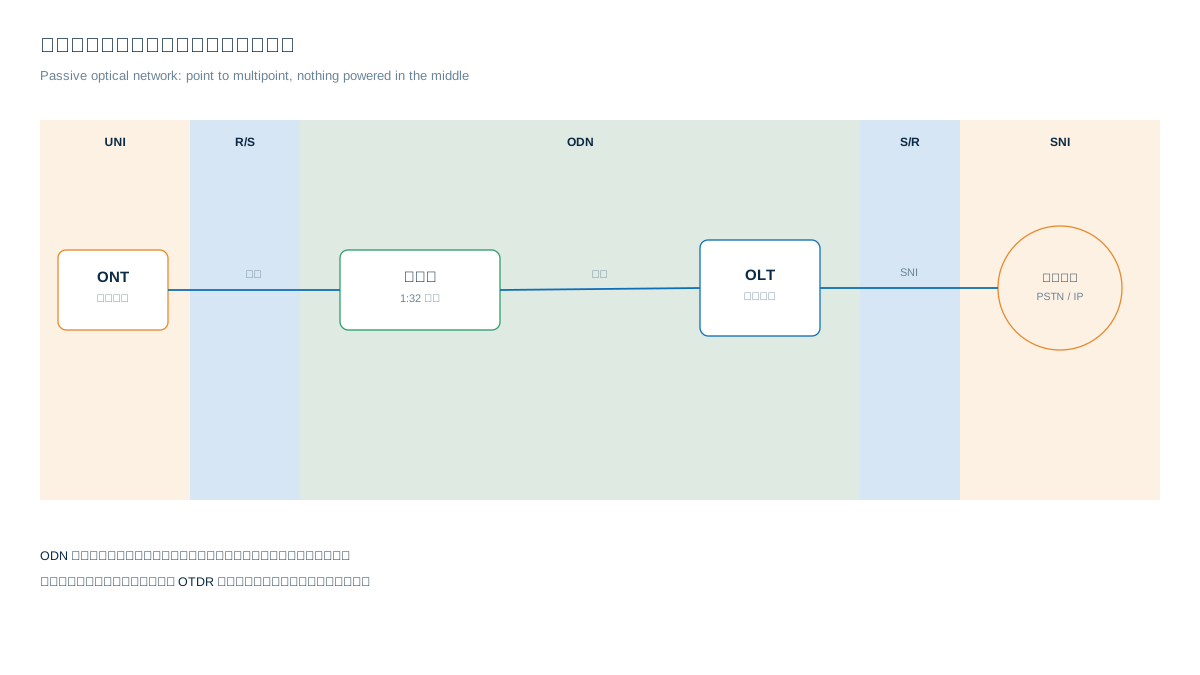
The structure
The OLT aggregates voice, data and video onto one feeder fiber. A passive splitter divides it N ways, one per ONU. Downstream, every ONU receives the same light and reads its own time slot; upstream, each transmits in its assigned slot under OLT scheduling.
What “passive” buys
- No power, no fans, no air conditioning in remote cabinets; with UPS at the head end, service survives a mains outage
- Failure points collapse from one active box per subscriber to splitters and connectors, an order of magnitude fewer
- The price is blindness: remote state is inferred from OLT registration and optical power, so faults still need a site visit
PON versus active Ethernet
Active Ethernet (AON) is point to point: one fiber, one transceiver pair and one switch port per subscriber. It gives dedicated bandwidth, long reach and faults you can locate instantly, but port and fiber count grow with every subscriber.
PON is point to multipoint: one fiber serves dozens of homes, which suits dense residential areas, but the 15 dB a splitter costs sets reach and split ratio against each other.
Real projects often run both: PON for new residential builds, AON for campuses and industrial sites where points are few, distances long and dedicated bandwidth is required.
Related products: PLC splitters · AWG modules · MPO / MTP connectivity