
Applications · Notes
How a GPON link spends its 28 dB
One fiber, one splitter, twenty kilometres: the budget lands right at the limit.
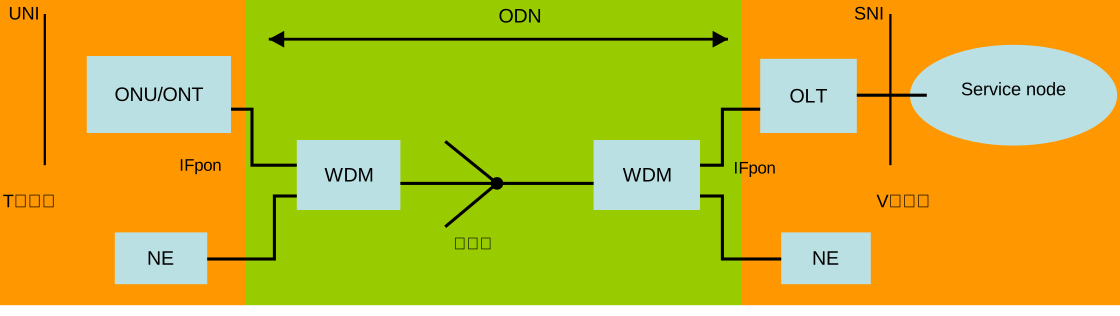
How the link runs
The OLT transmits downstream at 1490 nm (2.5 Gbit/s) and receives upstream at 1310 nm (1.25 Gbit/s) on the same fiber. In between sits the ODN: fiber, connectors and splitters only, nothing that needs power. The ONU splits the light back into voice, data and video for the CPE.
Upstream is shared. Each ONU transmits only in its own time slot, and ranging aligns the transmit timing across subscribers; small distance differences are absorbed as equalisation delay.
Where the 28 dB goes
- 1:32 splitter: about 15-17 dB, the largest single item
- 20 km of G.652 fiber: roughly 0.35 dB/km at 1310 nm, so about 7 dB
- Connectors, splices and ageing margin: keep 3-4 dB
What 1:64 would need
Together these land exactly on the 28 dB of Class B+. Going to 1:64 therefore means either Class C+ optics (32 dB) or a shorter reach; neither can be skipped.
Three problems seen on site
**Cascaded splitters.** A 1:8 feeding a 1:4 costs 0.5-1 dB more than a single 1:32, and a fault in the fiber between the two stages is very hard to locate. Use one stage whenever possible.
**Upstream errors.** ONU launch power drifts with temperature: receive power looks fine while the error rate climbs, which usually means an ageing ONU or a dirty ferrule.
**Contaminated end faces.** A single dust particle can cost a dozen dB at 1310 nm; clean first, then blame the part.
Related products: PLC splitters · Isolators & PM components · AWG modules